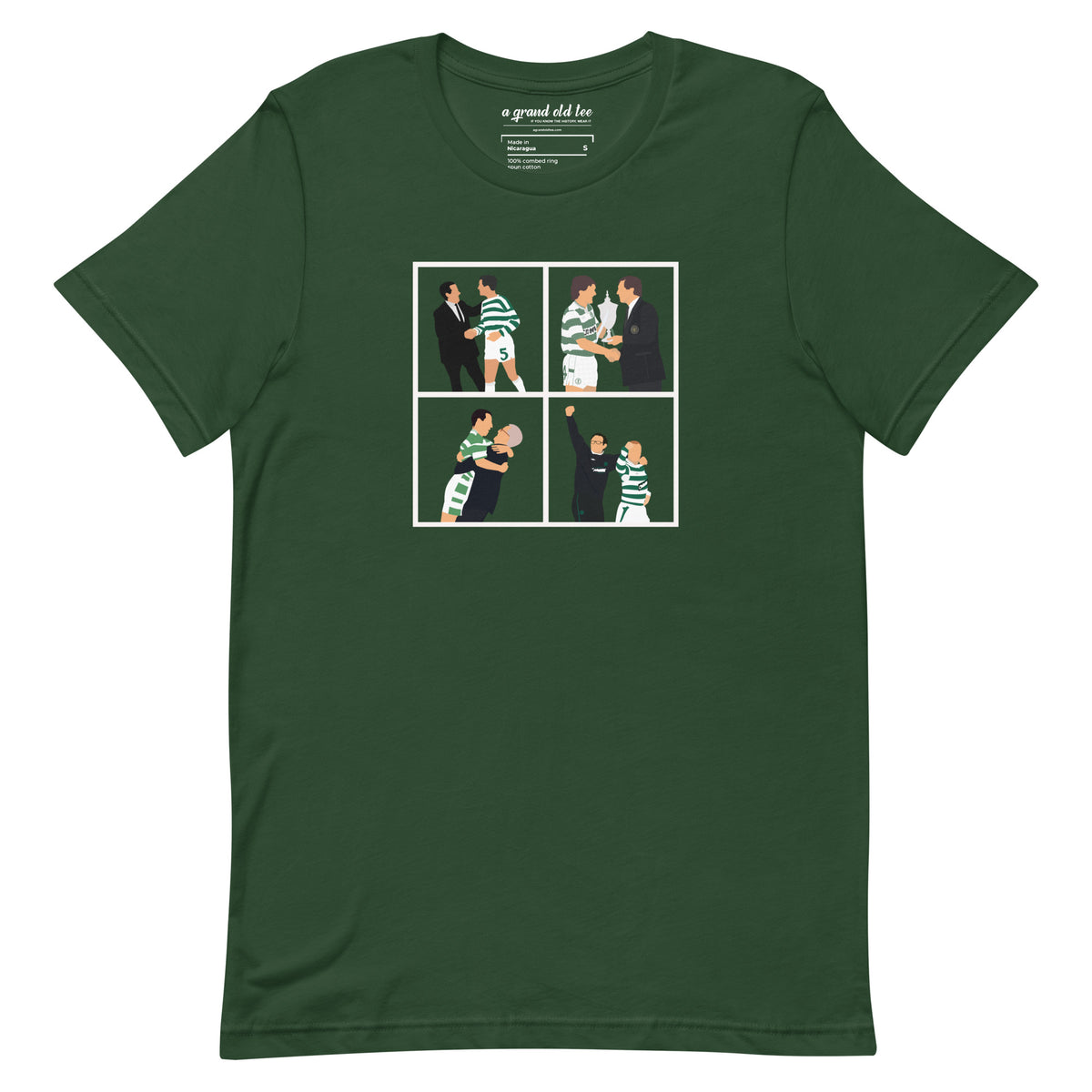
Stein and McNeill in '65. Aitken and McNeill in '88. McStay and Burns in '95. O'Neill and Lennon in '04. The captain and his manager. Repeat, almost rhyming, across half a century.
The Magic Moments tee draws the line through four of them. Quiet design that a supporter will recognise across a station platform, and a stranger will simply read as well-made graphic work.
Celtic had a new boot deal lined up for the 1967 European Cup Final. Boots with the famous three stripes.
But Neilly Mochan, the Celtic kitman, was not about to send his players out for the biggest match in the club's history in boots they hadn't broken in. So he took the boots they already wore, and painted them. Three stripes added on the side. The big cat logo on the heel coloured in. In photographs from that night, on Cesar's boots, you can still see Mochan's handiwork.
That night, Cesar led the Lisbon Lions to the most famous result in British football. The gesture, the quiet professionalism that prepared those boots, is what the design holds.
A small story about a small moment, half an hour before the biggest moment of all.
Unisex sizing. See chart in product images.
Soft, mid-weight organic cotton. Stanley Stella Creator 2.0, GOTS-certified.
A Grand Old Tee is for Celtic supporters who know their history, and want to wear it without dressing like it's match day. Every tee starts with a story.
Celtic 3-1 Hearts on the final day. Martin O'Neill's fairytale, Hearts' season-long lead, a 56th title. So why did the back pages lead with something else?
The release of the Austin Trusty VAR audio offers a rare glimpse inside the decision-making process of Scottish football officials. What emerges is not simply a debate about a red card, but a revealing look at how language, hierarchy and framing can shape outcomes.
This article examines how the senior VAR’s declarative statements may have guided the discussion, how key counterfactuals around defensive pressure were narrowed, and why the cultural implications matter far beyond one match.
In a league where trust in officiating has long been fragile, the real issue may not be bias, but how certainty is constructed and endorsed at the very top.
A bold new proposal for Scottish football: a 20-team Premiership split into four leagues, with every match counting toward a league title. No more splits, more variety, and big games like Celtic vs Rangers still played four times. Could this be the future of the SPFL?